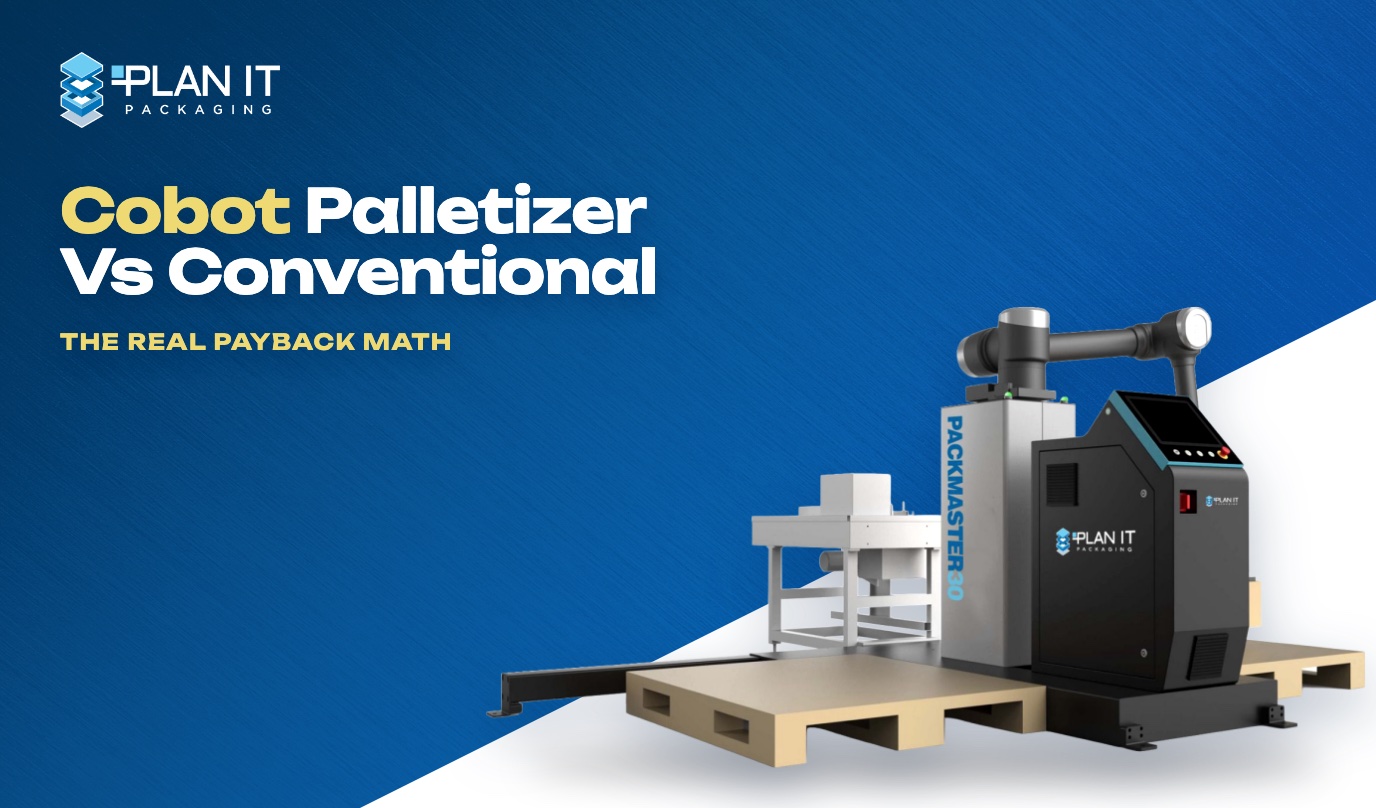
Stacking cases onto a pallet is some of the hardest, most repetitive work on a packaging line. A cobot palletizer can take over that lifting while your team moves to higher-value work. The real question is which palletizing approach fits your line, and what it pays back.
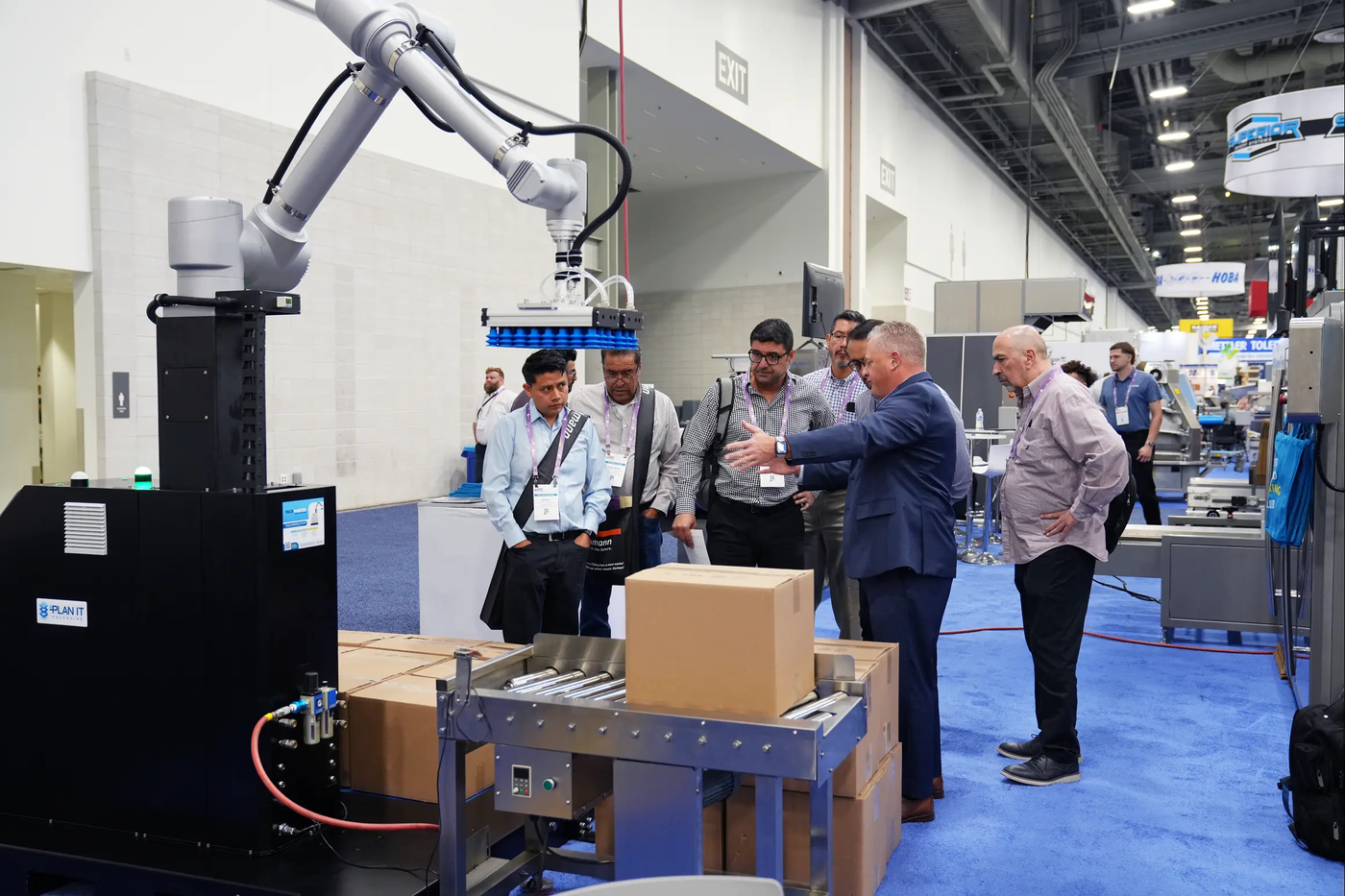
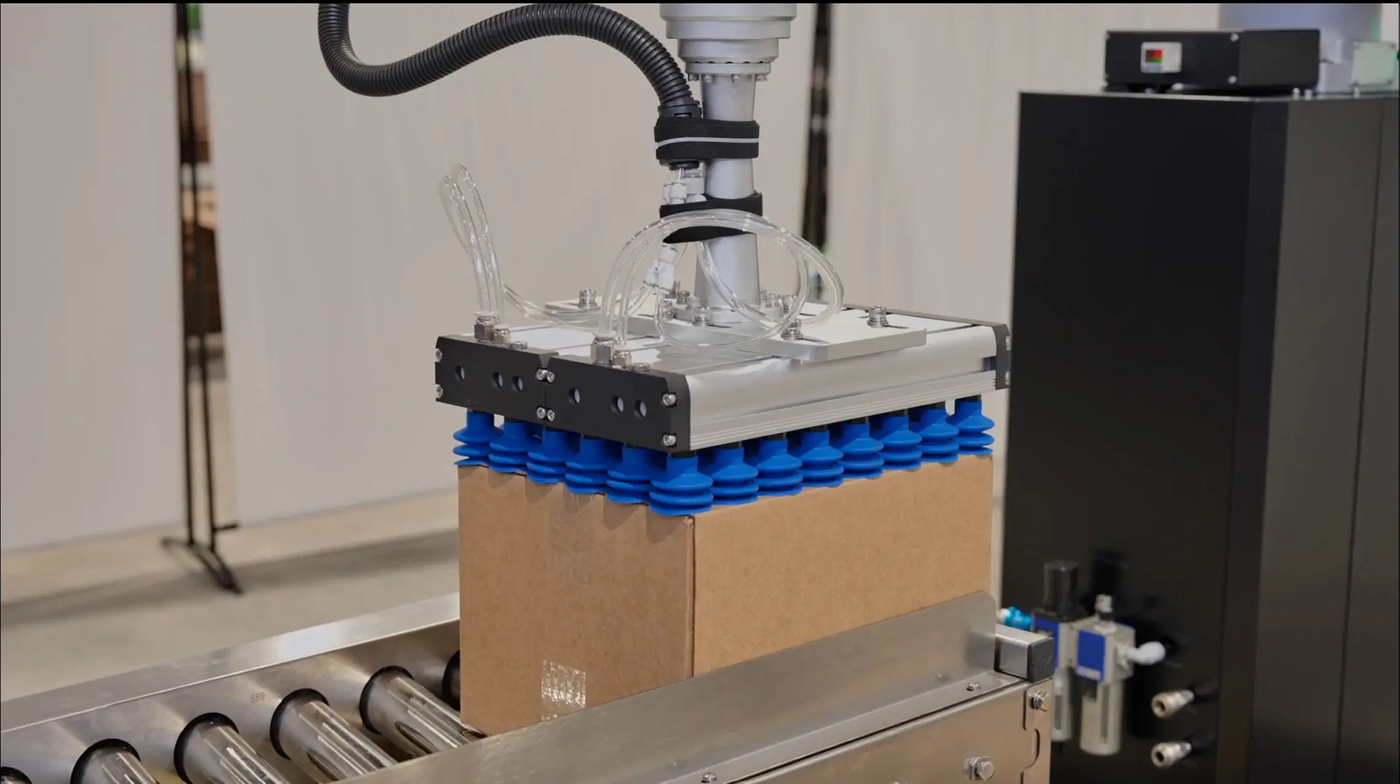
A cobot palletizer is a collaborative robot arm set up to pick cases, bags, or trays off a conveyor and stack them onto a pallet in a set pattern. "Cobot" is short for collaborative robot. As a palletizing robot, it automates one of the heaviest material handling jobs at the end of the line, and it is built to work alongside people rather than behind a fence.
The system has a few core parts:
The operator builds or uploads the pallet pattern in the software, usually through a touchscreen interface. The arm then repeats that pattern, case after case, with steady precision. Many systems let you store several patterns and switch between them, which helps on lines with high SKU variety.
That is the plain mechanics of it. The more useful comparison is how this approach stacks up against the conventional robotic palletizer most plants already know.
The two are not rivals so much as tools for different jobs. A conventional caged palletizer, whether a traditional industrial robot or a mechanical layer palletizer, is built for sustained high throughput. A cobot palletizing solution is built for flexibility, a small footprint, and working near people, which can mean better efficiency on a line with many changeovers than a conventional robotic palletizer delivers.
Here is how the two compare on the factors that matter when you plan a line.
The throughput and footprint figures above are vendor-typical planning ranges, not fixed specifications. One note of caution on the numbers: a cycle is not the same as a case. One cycle can move several cases at once, so compare like with like when a rate is quoted.
The pattern is simple. The more your line changes formats and the tighter your floor space, the more a cobot palletizer earns its place. The steadier and heavier your run, the more a conventional palletizer makes sense.
A cobot is not safe just because it carries the "collaborative" label or runs without a cage. Safety comes from the whole application: the arm, the gripper, the load, the speed, the layout, and how people work around it.
The core idea is Power and Force Limiting, or PFL. In this mode, the system limits the robot's power and force so that expected contact with a person does not cause injury. Several standards govern this work:
That is where safety becomes more than a feature on a spec sheet. It is a process. OSHA's guidance is clear that a risk assessment should be performed at each stage of a robot application, even a collaborative one, and that any safeguards follow from it. A heavy or falling load, a sharp gripper, or a pinch point near the pallet can still call for added guarding. "No cage" is not the same as "no risk assessment."
The practical payoff is real, though. A conventional palletizer keeps people out with a physical barrier. A collaborative palletizer, assessed and set up correctly, can let an operator load infeed, clear a jam, or check quality a few feet away while the arm keeps stacking. That is the whole point of the design.
Numbers decide these projects, so here is a worked example. Treat every figure as illustrative. The point is the method, not the exact dollars. Your own labor cost, run hours, and injury history will change the result.
Picture a two-shift line with one manual palletizing position on each shift. The cost that task carries today looks like this:
Now the cobot palletizing cell:
A note that matters: the cell does not remove the two team members. It takes the repetitive lifting off them. They move to work the cobot cannot do, such as quality checks, changeovers, infeed tending, and line supervision. The payback compares the cell cost against the annual cost the manual palletizing task carries today.
Simple payback works out to $140,000 divided by about $129,000 a year, which is roughly 1.1 years, or about 13 months. After that, the reclaimed hours and the lower injury exposure keep adding up.
Every plant's numbers are different. To run this with your real figures, use our investment calculators, and if the capital timing is the sticking point, our financing options can spread the cost.
Automated palletizing is not a fit for every product or every rate. A cobot palletizing system tends to suit:
It is less suited to very high, steady case rates or very heavy unit loads. Those jobs point back toward a conventional palletizer. The honest answer often depends on one question: is palletizing your bottleneck, or is it just the least pleasant job on the line? Both are good reasons to automate, but they lead to different sizing.
One of the strongest arguments for a cobot palletizer is how approachable it is to run. Traditional industrial robots usually need specialized programming. Collaborative systems lean on guided software and an intuitive touchscreen, so a trained operator can build a new pallet pattern, adjust a stack, or switch formats without a robotics background.
A typical deployment follows a clear path:
A cobot palletizer can also be integrated into an existing production line without a major rebuild, which keeps the project small and the disruption low. Good installation planning is where downtime is won or lost. A cell that an operator can adjust without a service call is a cell that keeps production moving, with steadier reliability shift to shift.
This is the part that gets framed the wrong way most often. A cobot palletizer is not about removing people from the floor. It is about taking the repetitive, labor-intensive lifting off them.
Manual palletizing is hard on bodies. The NIOSH Revised Lifting Equation shows why: its 51 lb load constant is the maximum under ideal conditions, and the safe limit falls once you add reach, lift height, twisting, and how often the lift repeats across a shift. End-of-line stacking rarely stays near ideal. Moving that task to a collaborative robot lowers the exposure and lets the team focus on work that needs human judgment: quality, changeovers, and keeping the line running.
The goal is balance. The arm handles the stacking. The operator handles the thinking. That balance is where real efficiency and productivity come from: steady automation on the repetitive work, and people on the judgment calls. Together they keep the line steady, productive, and safer for the people on it.
At PLAN IT Packaging, we believe automation is strongest when it supports people rather than stands in for them. Because when the hardest lifting is handled by a machine, your team can spend less time straining at the end of the line and more time keeping production moving. Our PackMaster cobot palletizer is built on that idea, and it pairs naturally with our RoboPacker robotic case packer to automate the full end of line.
A cobot palletizer is a collaborative robot arm that picks cases, bags, or trays off a conveyor and stacks them onto a pallet in a programmed pattern. The operator sets the pallet pattern in software, usually on a touchscreen, and the arm repeats it with steady precision. Built-in sensors let it work near people rather than behind a cage.
The main differences are safety model, speed, and footprint. A cobot uses Power and Force Limiting and can share floor space after a risk assessment, while a conventional palletizer uses a cage or guarding. A cobot typically places about 5 to 15 items a minute in a compact cell, while a conventional system runs faster but needs more space.
They can be safe when the whole application is assessed and set up correctly. Collaborative operation follows standards such as ISO 10218 and ISO/TS 15066, adopted in the U.S. as RIA TR R15.606. A risk assessment is still required, because a heavy load, a sharp gripper, or a pinch point near the pallet can call for added safeguards even without a cage.
Start with the product weight, the case or bag size, the pallet height, and the rate you need. Confirm the robot's payload includes the gripper weight, and check whether a lift column or seventh axis is needed to reach full pallet height. Then weigh your SKU variety and floor space. High variety and tight space favor a cobot; steady, heavy, high-speed runs favor a conventional palletizer.
Palletizing is not just the last step on the line. It is a safety, staffing, and uptime decision, and the right system depends on your product, your rate, and your floor space. We are glad to walk your line and size a palletizing solution around how your operation actually runs.
Let's PLAN IT Together! Call us at 1-866-339-3407 or tell us about your line here.