


March 22, 2024
In the highly competitive food industry, every detail matters – including how your products are packaged. For most businesses, the choice between vertical form fill seal (VFFS) and horizontal form fill seal (HFFS) machines is a critical decision that can significantly impact efficiency, quality, and costs.
This article aims to provide a comprehensive comparison of these two technologies to help you make an informed choice.
VFFS machines operate vertically. A roll of film is fed into the machine, where it’s formed into a tube around a fill tube. The product is then filled from the top, and the tube is sealed and cut to create individual packages.
VFFS machines are suitable for a broad range of products but are particularly effective for free-flowing products like granules, powders, and liquids. They are commonly used in the packaging of snacks, coffee, pet food, seeds, grains, and frozen vegetables.
VFFS machines are known for their high-speed operation and efficiency. They can produce a large number of packages quickly and are suitable for a wide range of package sizes and types, including pillow bags, gusset bags, and quad seal bags.
They require less floor space compared to HFFS machines, making them a good option for businesses with limited production space. They’re also versatile in terms of packaging materials.
VFFS machines can be challenging to use with fragile products, as the vertical filling process can potentially damage delicate items. They may also struggle with products that don’t flow freely, such as sticky or irregularly shaped products.
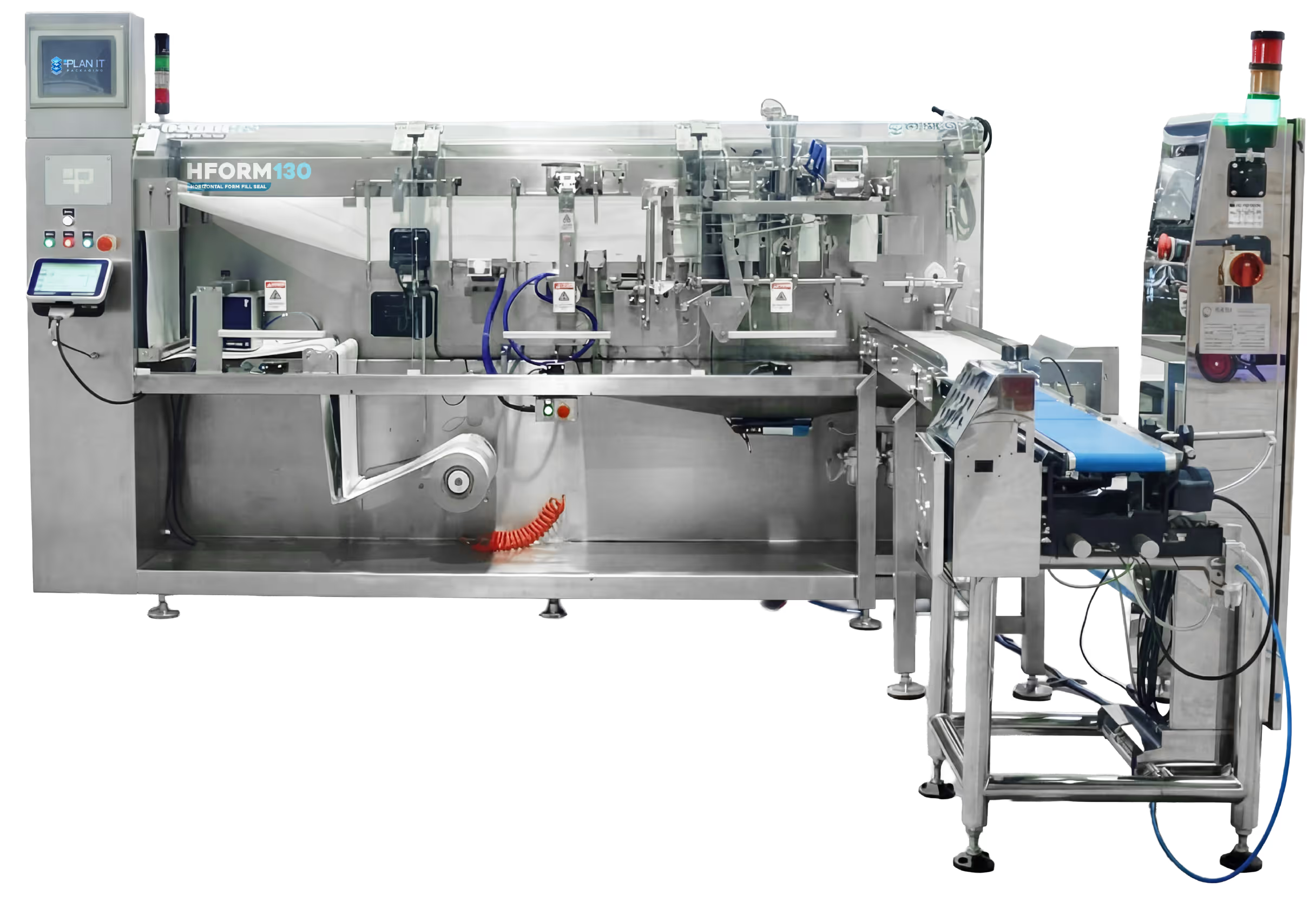
HFFS machines operate horizontally. A roll of film is guided through the machine horizontally, formed into a tube, filled with the product, and then sealed and cut to create individual packages.
HFFS machines are ideal for packaging solid products with a consistent size and shape. They are commonly used for packaging products like biscuits, chocolates, breads, vegetables, cheeses, and meats.
HFFS machines are designed to handle solid products with care, reducing the risk of product damage. They offer excellent flexibility, capable of handling different shapes and sizes of products.
HFFS machines can also work at high speeds and can accommodate a wide range of packaging materials and designs.
HFFS machines require more floor space than VFFS machines due to their horizontal operation. They may also be less suitable for free-flowing products like liquids or fine granules.
Comparing the two, VFFS machines are better suited for free-flowing products and situations where space is at a premium. They are generally capable of running at higher speeds and are more adaptable to a variety of product types.
HFFS machines, on the other hand, are ideal for solid, consistently-shaped products and offer superior product handling. They provide a more controlled packaging process but require more floor space.
There are several key factors to consider when choosing between VFFS and HFFS machines.
Understand your product’s properties: if it’s free-flowing, a VFFS machine is likely more suitable. For solid, consistently-shaped products, an HFFS machine would be a better fit.
Consider space constraints: VFFS machines are more compact, while HFFS machines require more floor space. Evaluate the speed and efficiency you need: VFFS machines are generally faster, while HFFS machines offer better product handling.
Think about the flexibility of packaging types: while both can handle a variety of packaging materials and designs, VFFS machines offer a wider range of bag styles.
Choosing the right machine is a critical decision for your business. Both VFFS and HFFS machines have their own unique advantages and challenges.
The right choice depends on your specific product, production requirements, and business goals. A deep understanding of your product’s properties, your space constraints, and the desired packaging outcome will be key to making the right decision.
If you need further assistance in making this decision, our team of experts is here to help.

%203.avif)


.svg)
.svg)
